The following graph shows the proportions of atmospheric gases as reported by NASA. The vast majority of the atmosphere is Nitrogen and Oxygen, which account for about 99% of the atmosphere. Of the remaining 1% (the expanded pie slice on the right), almost all of it is Argon (0.93%). The tiny red slice is Carbon Dioxide, which accounts for 0.035% of the Earth's atmosphere. On days with normal or higher humidity, water is the third largest component gas in the atmosphere. Water vapor is a powerful greenhouse gas , but water vapor's concentration in the atmosphere is highly variable. Of all the greenhouse gases,water vapor has the largest impact on global temperature because of its relatively high concentration in the atmosphere, far outstripping the effects of methane and Carbon Dioxide combined (water vapor accounts for 2/3 of today's greenhouse gas warming). In fact, without the warming effect of water vapor, Earth would have an average temperature below freezing (this actually occurred at the end of the Precambrian).
Saturday, March 2, 2019


Tuesday, June 21, 2016
Global warming. The good, the bad, the ugly and the efficient

A view of Earth seen from the International Space Station (ISS) taken by current ISS crew member, Russian cosmonaut Mikhail Korniyenko.
Global climate change has been portrayed largely as an unmitigated catastrophe for humans and the environment but, in reality, the topic is more nuanced. Although scientists agree that the climate is changing and many accept that anthropogenic increases in CO2are to blame, there is actually both good and bad news about global warming—and some ugly news about abatement strategies. The media and the scientific literature pay little attention to the possible benefits for some parts of the world of a warming climate; bad news always attracts more attention.-A warmer climate, especially during the winter months, would mean a longer growing season in all parts of the world that now experience frost and snow during the winter. Any part of the world above 40º North will probably enjoy less ice and freezing weather, and a greater number of warmer days in the future.
So far from being a villain, carbon dioxide is essential to life on earth.- Why is plant growth way up? Because of all the extra carbon dioxide in the air. According to the study, which was published this week in the scientific journal Nature, the total area of the planet that's covered by plants has increased by more than 11 million square miles in the last 33 years.
Friday, December 13, 2013
Ancient Fresh Water Lake On Mars Could Have Sustained Life

Drill hole in an ancient mudstone on Mars. (Credit: Image courtesy of Imperial College London).
Scientists have found evidence that there was once an ancient lake on Mars that may have been able to support life, in research published recently in the journal Science.
The team's analysis showed that the lake was calm and likely had fresh water, containing key biological elements such as carbon, hydrogen, oxygen, nitrogen and sulphur. Such a lake would provide perfect conditions for simple microbial life such as chemolithoautotrophs to thrive in.
"It is exciting to think that billions of years ago, ancient microbial life may have existed in the lake's calm waters, converting a rich array of elements into energy. The next phase of the mission, where we will be exploring more rocky outcrops on the crater's surface, could hold the key whether life did exist on the red planet." Cited from Science http://www.sciencedaily.com.
Sunday, November 24, 2013
Etna eruption produces beautiful steam rings

Etna continues to produce beautiful steam rings.
Update Sat 23 Nov 10:37
Update Sat 23 Nov 10:37
The latest paroxysm at the New SE crater started this morning. Strombolian explosions increased quickly and are now merging into lava fountains. You can follow the activity live at webcams.volcanodiscovery.com
Friday, February 11, 2011
Fish in the Santana Formation of Brazil

Fish remains of remarkable state of preservation and beauty have been found in calcareous concretions in the Santana Formation of north-east Brazil. The fossil-bearing concretions occur in the Araripe Basin at various localities at the boundary between Ceara, Pernambuco, and Piaui provinces. The strata containing the fish concretions lie at the base of the Araripe Plateau and are of Cretaceous age (Aptina-Albain, about 100 million years). At that time, Africa and South America were starting to rift apart and the South Atlantic was opening up in a narrow shallow sea. It is thought that salinity changes may have been responsible for the mass deaths of the marine fish fauna. The fish shown here has a length of 43 cm. Photos by P.Stacher.


Saturday, May 1, 2010
Deepwater Horizon oil spill.
 The Deepwater Horizon oil rig owned by Transocean has drilled the deepest oil well in history (35,050 feet) in September 2009 in the Gulf of Mexico. In January, the rig started operation at a British Petroleum project, approximately 41 miles offshore Louisiana on Mississippi Canyon block 252. On April 20 a fatal explosion occurred on the rig. Of the 126-member crew, 115 were safely evacuated. Despite exhaustive rescue efforts, eleven crew members lost their lives, nine of which were Transocean employees. After an unsuccessful effort to douse the fire, the remains of the rig sank to the ocean floor 5,000 feet below.
The cause of the incident is not known at present. It is assumed that a minor blow-out has occured. Oil and gas, was flowing from the formation into the wellbore and was rising undetected up to the rig floor where the gas was ignited. After the explosion it was not possible anymore to shut the well by activating the underwater blowout-preventer (BOP). It was reported that the rig had apparently just finished cementing steel casing before the well was to be suspended. The plan was to re-enter the well later with another rig to complete the work and bring the well into production.
The Transocean Deepwater Horizon is a floating rig that moves with the waves. The pressure control equipment sits on the seabed and is controlled remotely from the platform. Although there are enormous safety measures in place to prevent drilling incidents the risks are always present in the industry. Transocean is one of the industry's most safety-conscious and experienced deep-water company that has recently moved head quarters to Zug, Switzerland.
A catastrophic amount of oil is spreading over the ocean and threatens land, wildlife and the seafood industry. An oil spill quite this bad had not been seen since the Exxon Valdez incident some twenty years ago.
Thursday, April 15, 2010
Eyjafjallajökull volcano eruption.

Eyjafjallajökull volcano eruption in south Iceland. Video by Icelandic National TV station RÚV. 24.03.2010. Music by Sion, Ambients, Freefalling. GPS coordinates of the eruption: 63.635° N, 19.440° W. YouTube Read about Eyjafjallajökull volcano: - Katla and Eyjafjallajökull Volcanoes: sciencedirect.com - Eyjafjallajökull eruption: 20 March to present: earthice.hi.is |
Friday, April 2, 2010
Ice Sheet Melt Identified as Trigger of 'Big Freeze'.

A new paper, which is published in Nature on April 1, 2010, has identified a mega-flood path across North America which channelled melt-water from a giant ice sheet into the oceans and triggering the Younger Dryas cold snap.
The study will help shed light on the implications of fresh water input into the North Atlantic today. There are current concerns that changes in the salinity of the ocean today, could cause another shut down of the Gulf Stream. Current climate changes, including global warming, may be altering the planetary system which regulates evaporation and precipitation, and moves fresh water around the globe. Cited from sciencedaily.com.
Friday, March 5, 2010
65 million years of climate change
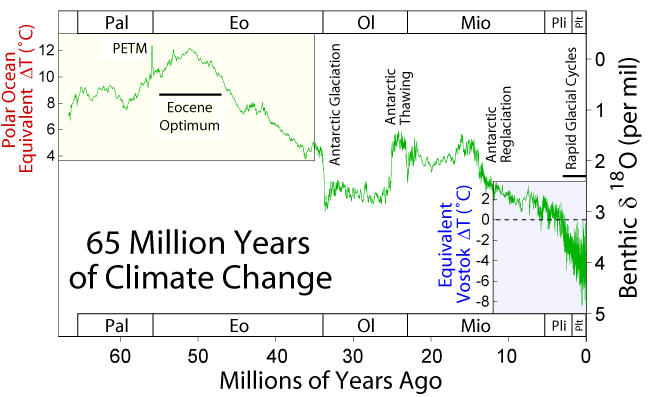
The planet earth is 4.5 billion years old and has undergone many geologial and climatic changes. Geologists know: Earth history demonstrates continuous dynamic evolution. The above figure shows climate change over the last 65 million years. The data has been gained from oxygen isotope measurements (δ18O) on benthic foraminifera by Zachos et al. (2001) and reflect a combination of local temperature changes in their environment and changes in the isotopic composition of sea water associated with the growth and retreat of continental ice sheets. Figure and citation from wikipedia.com.Ancient climate records provide clear evidence of abrupt episodes of greenhouse warming in the past. Understanding cause and effect for these events continues to remain a major challenge. For the best-documented example, a burst of warming some 55 million year ago termed the Palaeocene–Eocene thermal maximum (PETM), known increases in greenhouse gases fail to explain even half of the observed warming. Read more..nature.com
Monday, January 18, 2010
Haiti earthquake occurred in complex, active seismic region
 Haiti earthquake occurred in complex, active seismic region. The magnitude 7.0 earthquake that triggered disastrous destruction and mounting death tolls in Haiti this week occurred in a highly complex tangle of tectonic faults near the intersection of the Caribbean and North American crustal plates, according to a quake expert at the Woods Hole Oceanographic Institution (WHOI) who has studied faults in the region and throughout the world.....read more...sciencedaily.com
Thursday, January 7, 2010
Microorganisms cited as missing factor in climate change equation
 Microorganisms cited as missing factor in climate change equation
Those seeking to understand and predict climate change can now use an additional tool to calculate carbon dioxide exchanges on land, according to a scientific journal article publishing this week.
The research, publishing in the Proceedings of the National Academy of Sciences, incorporates into global computer models the significant impact an enzyme, carbonic anhydrase, has on the chemical form of carbon dioxide released from the soil and reduces uncertainties in estimates of CO2 taken up and released in terrestrial ecosystems.
The same enzyme is present in foliage and soils, but leaves a different imprint on CO2 involved in photosynthesis and respired by soils.
"Our paper presents measurements from all the major regions of the world where we have experimentally determined the effect of this enzyme, produced by many microorganisms, on carbon dioxide released from the soil," said Dr. Behzad Mortazavi, an assistant professor of biological sciences at The University of Alabama, and a co-author of the article.
from sciencedaily.com
..read more.."Our paper presents measurements from all the major regions of the world where we have experimentally determined the effect of this enzyme, produced by many microorganisms, on carbon dioxide released from the soil," said Dr. Behzad Mortazavi, an assistant professor of biological sciences at The University of Alabama, and a co-author of the article.
from sciencedaily.com
Wednesday, December 9, 2009

Sunday, October 11, 2009
Alpine glaciers in retreat.

 Swiss glaciers are melting away at an accelerating rate and many will vanish this century if climate projections are correct. The Rhone glacier has been a tourist attraction since the middle of the nineteenth century.
The scenic glacier next to the road over the Furka pass retreated dramatically over the past 150 years. Pictures from 1870 show the ice reaching to the village of Gletsch in the valley. Now the ice is almost 3 km further back disappearing behind
 the edge
of a 450 m high ice-polished slope. A lake is forming at the foot of the shrinking Rhone glacier.
Sunday, October 4, 2009
Ardi sheds light on the origin of man.
 A research team headed by Tim White discovered in 1992 the first Ardipithecus ramidus fossils from the Afar Depression in the Middle Awash river valley of Ethiopia. More fragments, including mainly teeth, were recovered in the following years allowing the composition of 45 percent of the total skeleton. The lines that evolved into modern humans and living apes probably shared an ancestor 6 million to 7 million years ago, in the Late Miocene. The fossils were dated as 4.4 million years of age based on its interval between the volcanic strata of the Gaala Tuff Complex and the Daam Aatu Basaltic Tuff. Studies under way indicate the species lived in the woodlands and could climb on all fours along tree branches, but the development of their arms and legs indicates they didn’t spend much time in the trees. And they could walk upright, on two legs, when on the ground. In its 2 October 2009 issue, Science presents 11 papers, authored by a diverse international team, describing the early hominid species, Ardipithecus ramidus, and its environment.
  These 4.4 million year old hominid fossils sit within a critical early part of human evolution, and cast new and sometimes surprising light on the evolution of human limbs and locomotion, the habitats occupied by early hominids, and the nature of our last common ancestor with chimps.
- Watch a movie by msnbc.msn.com
Literature:- Understanding Human Origins. Light on the Origin of Man.
- World’s oldest human-linked skeleton found.
- Meet Ardipithecus Ramidus - Early Hominid Common Ancestor Was Neither Chimp Nor Human, Says Study.
- Ardipithecus ramidus - An ancestor of humans and apes?
- Ardipithecus ramidus. Hominidae species overview in Archaeologyinfo.
- Humanity Has a New 4.4 Million-Year-Old Baby Mama.
Wednesday, July 8, 2009
Côte Sauvage. Wild Coast of Quiberon Peninsula.

 The Quiberon Peninsula was originally an island and has been joined to the mainland by the accumulation of sand washed up by the sea. Its wild scenery - particularly impressive along the Côte Sauvage on the western side - attracts many
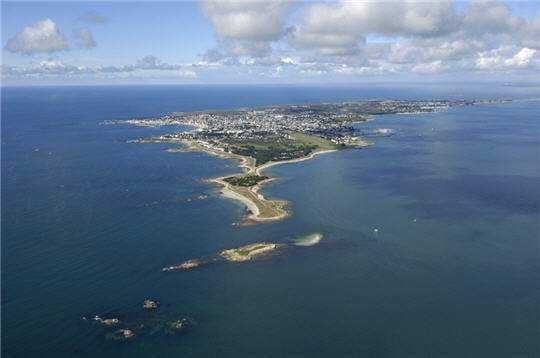 visitors. The cliffs are made up of two-mica granites. Geologists have newly interpreted the Quiberon area in the Variscan belt of South Brittany (France) as a crustal shear zone and have postulatred Carboniferous extension tectonics as evidenced by normal faults, high- and low-grade migmatites and synkinematic emplacement of the Quiberon granite pluton. Quiberon is a well-known seaside resort and has some attractive beaches on the sheltered eastern coast.
Read more about Quiberon:
- Rapid Variscan exhumation and the role of magma in core complex formation: southern Brittany metamorphic belt, France
- Armorican Massiv Geological Map
- Quiberon peninsula
Wednesday, April 22, 2009
Plateosaur Discoveries.
 During the Late Triassic (about 210 million years ago) large sauropodomorphs dominated terrestrial environments.
In Europe Plateosaurs were widespread as heavy, long-necked, long-tailed herbivores up to 8 meters long.
There is a complete skeleton of a plateosaurus on display in the dinosaurs museum at Frick in Switzerland. Dinosaurs were discovered at Frick in the 1980's and 1990's at the clay quarry Gruhalde in a formation called "Bunten Mergel" (varicolored marl). In Late Triassic times the area of todays northern Switzerland was a vast, desertlike lowland with a tropical climate. Frick is one of the most important places of plateosaurs discoveries in Europe. Source: Sauriermuseum Frick.
Read more about plateosaurs:
The Anchisaur-Plateosaur Empire
The Norian Age
Dinosaurier Funde gesichert – weitere Grabungen in Frick geplant
Tuesday, February 10, 2009
Rhine Falls.

 Glaciation and warm interglacial periods of the past 500'000 years have shaped the landscape from the high rising Alps down to the northern lowlands of Switzerland. In the area of Schaffhausen the river Rhine has changed its course several times eroding Jurassic limestone and filling channels with gravel and sand. At the location of the famous Rhine waterfall the present-day river bed consists at the upper side of hard Jurassic (150 million years old) limestones which terminate in a cliff bordering gravel beds of an abandoned river channel formed by the ancient Rhine during Riss age (about 120'000 years old). The waterfall developped about 15'000 years ago, after the new Rhine started to erode the soft Riss-age gravel and sands.
Literature:
Albert Heim, 1931, Geologie des Rheinfalls.
Der Rheinfall, Neujahrsblatt der Naturforschenden Gesellschaft Schaffhausen, Nr. 39, 1987.
http://www.rua.ch/rhein/Region03Destination01Entstehung.htm

The Rhine Falls are the largest waterfalls in Europe.
Latitude: 47.677871
Longitude: 8.614482
Panoramio
Photo Stadtarchiv Schaffhausen
Thursday, January 29, 2009
Darwin Online.
Check out the website offering the complete work of Charles Darwin online for free > Darwin Online.
 The Complete Work of Charles Darwin Online (or Darwin Online) began in 2002 to assemble in one scholarly website all of Darwin's published writings and unpublished papers. It does not cover his unpublished letters which were already the focus of the Correspondence of Charles Darwin.
Darwin Online is the largest and most widely used Darwin resource ever created. More copies of Darwin's works have been downloaded from Darwin Online than were published in Darwin's lifetime or in the whole of the 19th century.
The site contains over 74,000 pages of searchable text and 182,000 electronic images. It contains at least one exemplar of all known Darwin publications, reproduced to the highest scholarly standards, both as searchable text and electronic images of the originals. The majority of these have been edited and annotated here for the first time.
 The Complete Work of Charles Darwin Online (or Darwin Online) began in 2002 to assemble in one scholarly website all of Darwin's published writings and unpublished papers. It does not cover his unpublished letters which were already the focus of the Correspondence of Charles Darwin.
Darwin Online is the largest and most widely used Darwin resource ever created. More copies of Darwin's works have been downloaded from Darwin Online than were published in Darwin's lifetime or in the whole of the 19th century.
The site contains over 74,000 pages of searchable text and 182,000 electronic images. It contains at least one exemplar of all known Darwin publications, reproduced to the highest scholarly standards, both as searchable text and electronic images of the originals. The majority of these have been edited and annotated here for the first time.
Saturday, January 24, 2009
Cave rocks reveal past climate changes.

 Stalagmites have been sampled from caves in China and other caves from all over the world. Split into half, stalagmites reveal banding like an agate. The layers of calcite indicate periods of wet and dry weather and changing contents of trace elements. The bands are annual growth rings like in a tree and reveal ages of up to 100'000 years. The University of Minnesota researcher Hai Cheng measures uranium and thorium contents and reconstructs a weather and climate history. Photo shown here were taken by Hai Cheng who grew up in China, but now is a research scientist in the Department of Geology and Geophysics at the University of Minnesota.
 Ref.: Ancient cave rocks reveal impact of climate change by Stephanie Hemphill
Cave gives clues to China's history.
In an article published in Science, the researchers say the stalagmite, found in Wanxiang Cave, China, told of strong and weak monsoon periods, which coincided with the rise and fall of several Chinese dynasties.
"....weak and consequently dry monsoon periods coincided with the demise of the Tang (618-907), Yuan (1271-1368) and Ming (1368-1644) dynasties."
"We have demonstrated that the cave records correlate well with many records, including the little ice age in Europe; the temperature changes in China and Northern Hemisphere and major solar variability."
Ref.: ABC Science : Cave gives clues to China's history.
Sunday, January 18, 2009
Subscribe to:
Posts (Atom)


 Posts
Posts