The following graph shows the proportions of atmospheric gases as reported by NASA. The vast majority of the atmosphere is Nitrogen and Oxygen, which account for about 99% of the atmosphere. Of the remaining 1% (the expanded pie slice on the right), almost all of it is Argon (0.93%). The tiny red slice is Carbon Dioxide, which accounts for 0.035% of the Earth's atmosphere. On days with normal or higher humidity, water is the third largest component gas in the atmosphere. Water vapor is a powerful greenhouse gas , but water vapor's concentration in the atmosphere is highly variable. Of all the greenhouse gases,water vapor has the largest impact on global temperature because of its relatively high concentration in the atmosphere, far outstripping the effects of methane and Carbon Dioxide combined (water vapor accounts for 2/3 of today's greenhouse gas warming). In fact, without the warming effect of water vapor, Earth would have an average temperature below freezing (this actually occurred at the end of the Precambrian).
Showing posts with label Climate. Show all posts
Showing posts with label Climate. Show all posts
Saturday, March 2, 2019


Tuesday, June 21, 2016
Global warming. The good, the bad, the ugly and the efficient

A view of Earth seen from the International Space Station (ISS) taken by current ISS crew member, Russian cosmonaut Mikhail Korniyenko.
Global climate change has been portrayed largely as an unmitigated catastrophe for humans and the environment but, in reality, the topic is more nuanced. Although scientists agree that the climate is changing and many accept that anthropogenic increases in CO2are to blame, there is actually both good and bad news about global warming—and some ugly news about abatement strategies. The media and the scientific literature pay little attention to the possible benefits for some parts of the world of a warming climate; bad news always attracts more attention.-A warmer climate, especially during the winter months, would mean a longer growing season in all parts of the world that now experience frost and snow during the winter. Any part of the world above 40º North will probably enjoy less ice and freezing weather, and a greater number of warmer days in the future.
So far from being a villain, carbon dioxide is essential to life on earth.- Why is plant growth way up? Because of all the extra carbon dioxide in the air. According to the study, which was published this week in the scientific journal Nature, the total area of the planet that's covered by plants has increased by more than 11 million square miles in the last 33 years.
Friday, April 2, 2010
Ice Sheet Melt Identified as Trigger of 'Big Freeze'.

A new paper, which is published in Nature on April 1, 2010, has identified a mega-flood path across North America which channelled melt-water from a giant ice sheet into the oceans and triggering the Younger Dryas cold snap.
The study will help shed light on the implications of fresh water input into the North Atlantic today. There are current concerns that changes in the salinity of the ocean today, could cause another shut down of the Gulf Stream. Current climate changes, including global warming, may be altering the planetary system which regulates evaporation and precipitation, and moves fresh water around the globe. Cited from sciencedaily.com.
Friday, March 5, 2010
65 million years of climate change
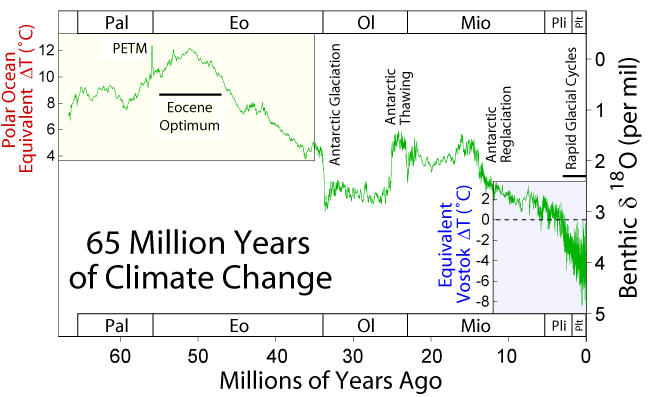
The planet earth is 4.5 billion years old and has undergone many geologial and climatic changes. Geologists know: Earth history demonstrates continuous dynamic evolution. The above figure shows climate change over the last 65 million years. The data has been gained from oxygen isotope measurements (δ18O) on benthic foraminifera by Zachos et al. (2001) and reflect a combination of local temperature changes in their environment and changes in the isotopic composition of sea water associated with the growth and retreat of continental ice sheets. Figure and citation from wikipedia.com.Ancient climate records provide clear evidence of abrupt episodes of greenhouse warming in the past. Understanding cause and effect for these events continues to remain a major challenge. For the best-documented example, a burst of warming some 55 million year ago termed the Palaeocene–Eocene thermal maximum (PETM), known increases in greenhouse gases fail to explain even half of the observed warming. Read more..nature.com
Subscribe to:
Posts (Atom)


 Posts
Posts